


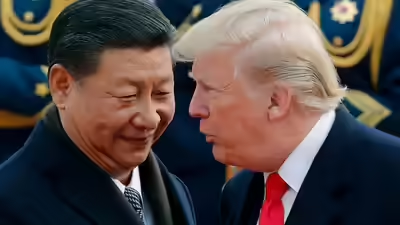
At the APEC Summit held in Busan, South Korea, a highly anticipated meeting took place between U.S. President Donald Trump and Chinese President Xi Jinping. The encounter came at a time when trade relations between the two world powers had been strained by tariff wars, supply-chain disruptions, and disagreements over technology and manufacturing control.
This meeting was viewed globally as an attempt to reset or at least stabilize the economic dialogue between Washington and Beijing after months of uncertainty.
What Happened During the Meeting
The meeting was held on the sidelines of the APEC sessions, lasting longer than expected. Both leaders were accompanied by top trade and diplomatic advisers. Discussions revolved around multiple key issues, including tariff reductions, agricultural trade, supply chains for medical goods, and the export of critical minerals such as rare earth elements — essential for advanced technology and defense industries.
According to officials familiar with the talks, the tone of the discussion was “firm but constructive,” signaling both caution and openness from each side.
Key Agreements and Announcements
- Tariff Reductions
President Trump reportedly agreed to scale back certain tariffs on Chinese imports in exchange for reciprocal steps by Beijing. The move was intended to ease market tension and boost bilateral trade flows. - Control of Fentanyl Chemicals
Both sides addressed concerns about the production and export of fentanyl precursors from China, which have been linked to the U.S. opioid crisis. China pledged to tighten its regulatory oversight on these substances, while the U.S. agreed to review some trade restrictions in return. - Agricultural Trade Resumption
China indicated it would resume large-scale purchases of U.S. soybeans and other agricultural goods, providing relief to American farmers who have suffered during the trade standoff. - Rare Earths and Critical Minerals
The leaders discussed cooperation over rare earth minerals — vital for technology manufacturing — and agreed to establish a framework to prevent supply disruptions in global markets. - Future Economic Dialogue
Both governments announced their intention to form a new “Trade Cooperation Working Group” to monitor progress, resolve disputes, and ensure the enforcement of mutual agreements.
Global Reactions
The meeting was largely welcomed by international observers and business leaders. Markets responded positively, viewing it as a signal of easing economic confrontation. Analysts noted that while the commitments made were limited in scope, they represented a significant thaw in relations that had been dominated by tariffs, sanctions, and mutual suspicion.
However, experts also warned that challenges remain — particularly in areas like technology transfer, cybersecurity, and intellectual property rights, where deep disagreements persist. The new agreements, they said, would only be meaningful if both sides follow through with transparent implementation.
Broader Implications
The Busan dialogue marked one of the most high-profile attempts to rebuild trust between the U.S. and China since the height of the trade war. The shift in tone — from confrontation to cautious cooperation — could have ripple effects across global supply chains and markets.
If the promises made during this summit translate into concrete actions, it could stabilize one of the world’s most crucial economic relationships. On the other hand, if enforcement falters or political tensions rise again, the progress may prove short-lived.
Conclusion
The Trump–Xi meeting at the APEC Summit symbolizes a tentative but hopeful step toward restoring trade balance between the world’s two largest economies. Both leaders emphasized the need for fairness and mutual benefit, framing the talks as a “new start” rather than a final solution.
While much remains uncertain, the dialogue in Busan showed that despite geopolitical rivalries, pragmatic diplomacy still has room to work — especially when global economic stability is at stake.