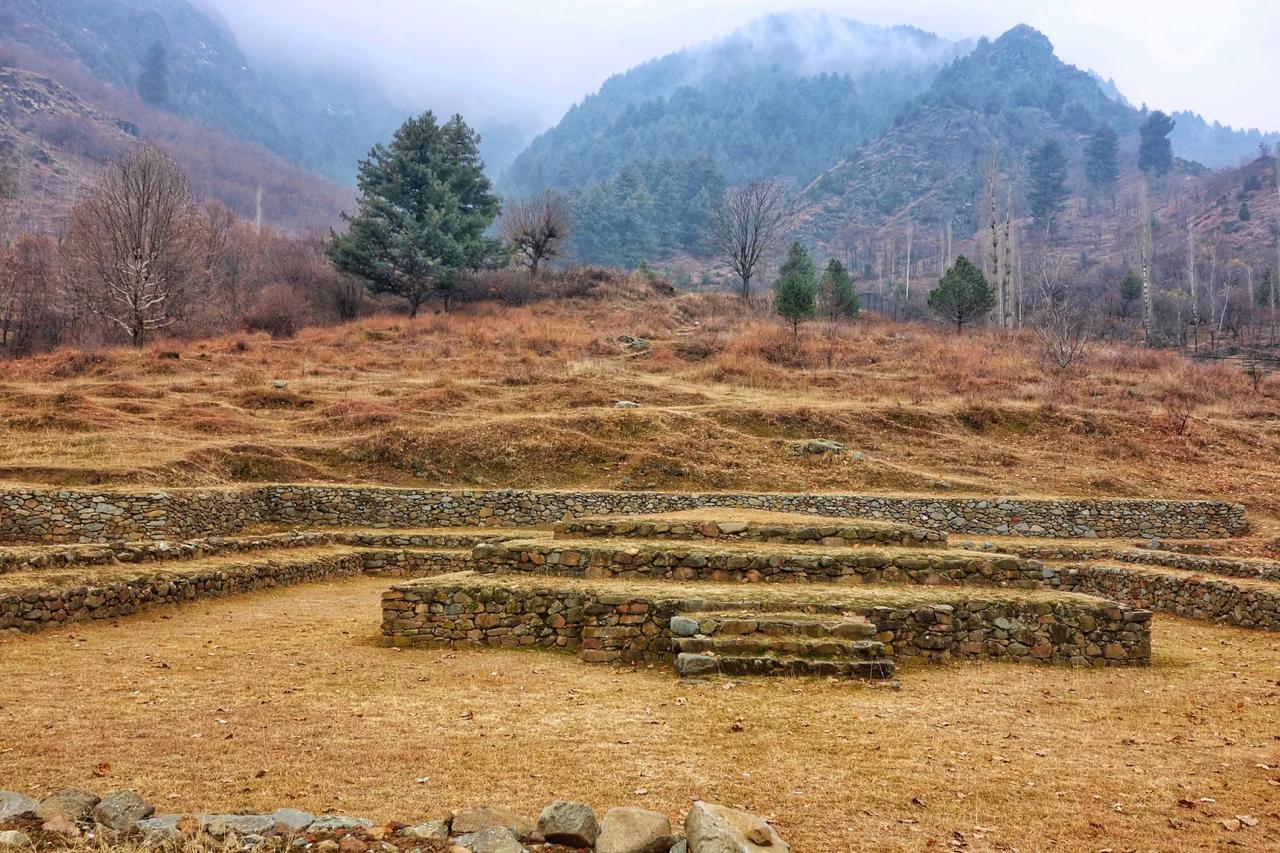
The legendary Chinese traveler Xuanzang, who visited India in the 7th century, wrote vividly in his book Great Tang Records on the Western Regions about the grand stupas, monasteries, and thriving Buddhist order in Kashmir.
For years, historians relied on his accounts, but physical proof remained limited.
Now, fresh archaeological discoveries have confirmed what the ancient texts claimed:
Kashmir was indeed a Buddhist heartland.
What Has Been Found?
Recent excavations across regions like Parihaspore (Parihaspura), Harwan, and upper Himalayan routes have revealed:
- Foundations of massive stupas
- Monastery walls, chambers, and assembly halls
- Fragments of Buddhist sculptures
- Pillar bases and circular stupa stones
- Artifacts tracing back to the Kushan and post-Kushan era
Archaeologists say the scale and architecture match the exact descriptions provided by Xuanzang nearly 1,300 years ago.
Why Was Kashmir a Buddhist Land?
Historical evidence shows:
- Emperor Ashoka extended strong state support to Buddhism in Kashmir.
- The region hosted large monastic universities where monks from Central Asia and beyond studied.
- During the Kushan Empire, Kashmir became one of the greatest centers of Buddhist scholarship.
- Xuanzang described Kashmir as “a land of learning and dharma.”
It was from Kashmir that Buddhism spread into Central Asia, Afghanistan, and China.
Why Did This Civilization Decline? — Dr. B.R. Ambedkar’s Insight
Dr. B.R. Ambedkar, in his historic work “Revolution and Counter-Revolution”, explained the reasons behind the downfall of Buddhism in India.
Kashmir’s decline fits precisely into those patterns:
1. Collapse of the Monastic Order
The Buddhist monkhood was not hereditary, which meant:
- Fewer new monks joined
- Monasteries slowly emptied
- The discipline and structure weakened
Meanwhile, competing religious institutions had stronger, hereditary and permanent structures.
2. Loss of State Patronage
When later rulers withdrew support:
- Monasteries lost funding
- Stupas fell into neglect
- Cultural identity started to shift
3. Waves of Religious and Cultural Attacks
Kashmir witnessed periods of invasion, conversion-driven politics, and social turmoil.
Many Buddhist structures were dismantled, burnt, or repurposed.
4. Weakening of Social Roots
As the social base of Buddhism eroded,
its survival became difficult, despite its moral and intellectual strength.
What Does This Discovery Prove?
These excavations reveal far more than stones:
They confirm that Kashmir’s identity once carried the fragrance of Buddha’s teachings—compassion, learning, and spiritual discipline.
The valley was not merely a land of conflict;
it was a cradle of wisdom.
Why This Truth Matters Today
Because it reminds us:
- India’s civilizational story is layered and diverse
- The legacy of Buddha is not just the past—it is guidance for the present
- Kashmir’s buried history still breathes beneath its soil
When the earth opens, it doesn’t reveal ruins;
it reveals who we once were.
Conclusion
The Kashmir that Xuanzang described—
where stupas touched the sky, where monasteries echoed with chants, and where scholars shaped Asia’s spiritual history—
is resurfacing before our eyes.
Kashmir is not just a geography;
it is a forgotten Buddhist chapter
now returning to light.