


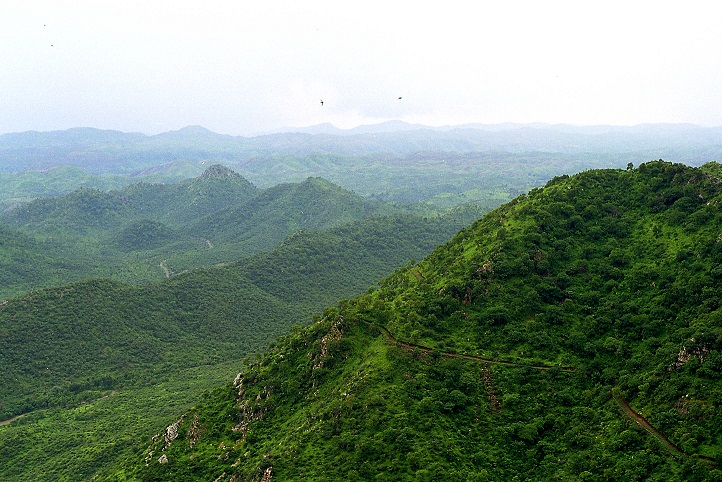
The mountain range once dismissed as “old and useless” has, in reality, been shielding North India from turning into a desert for centuries—this fact has emerged clearly from documents and geological studies.
Investigations have also revealed that the areas where the Aravalli hills were cut down were the first to experience deterioration in water availability, air quality, and temperature—this is not a coincidence, but a direct cause-and-effect relationship.
Investigations reveal that the Aravalli mountain range is not merely a geological formation, but the backbone of North India’s environmental balance. Geological records indicate that the Aravalli is between 150 and 250 crore years old, placing it among the oldest mountain ranges in the world. Stretching from Palanpur in Gujarat to Delhi, it covers vast regions of Rajasthan, Haryana, and the national capital.
Studies clearly show that the Aravalli acts as a natural barrier between the Thar Desert and the fertile plains of the Ganga basin. Wherever the Aravalli hills have weakened or disappeared, desertification, dust storms, and land degradation have intensified rapidly. Experts believe that the erosion of the Aravalli has allowed dry western winds to move unhindered toward the interior regions.
The investigation has also brought to light that the Aravalli region is a major groundwater recharge zone. Its rocky formations trap rainwater and allow it to percolate deep into the ground. Areas where the Aravalli remains intact still sustain traditional wells and water bodies, while regions where the hills were cut down have witnessed a dangerous decline in groundwater levels.
Reports from forest and environmental departments further reveal that the Aravalli has long been a critical center of biodiversity. Leopards, jackals, nilgai, foxes, hundreds of bird species, and rare plant varieties once thrived here. However, relentless urban expansion and mining activities have steadily shrunk their natural habitats.
One of the most alarming findings relates to illegal mining. Investigations show that for decades, hills were cut down by bypassing regulations. Entire hillocks were wiped out in the name of extracting stone, gravel, and minerals. Subsequently, farmhouses, residential colonies, and commercial constructions emerged on the same land.
Orders from the Supreme Court and the Ministry of Environment have repeatedly emphasized declaring the Aravalli a protected zone, but compliance on the ground has remained limited. Documents indicate that in many cases, the Aravalli was classified as revenue land to evade conservation obligations.
Environmental experts warn that if the current degradation of the Aravalli continues unchecked, rising temperatures, acute water scarcity, and worsening air pollution will become permanent features of Delhi-NCR and surrounding regions. This is not merely an environmental concern, but a question tied to the survival of future generations.
The conclusion of this investigation is clear—damaging the Aravalli is not just about cutting down hills; it is about weakening North India’s natural line of defense. If a balance between development and conservation is not restored, the consequences will not remain confined to reports, but will visibly impact everyday life.
This story is not based on imagination, but on established facts, studies, and ground realities—and that is the unseen, undeniable truth of the Aravalli.